Affiliate disclosure: This guide contains affiliate links. Purchases may earn us a commission at no extra cost to you.
A predator-proof chicken setup needs six-sided protection: secure walls, a strong roof or covered top, protected openings, a dig-resistant perimeter, a solid coop floor or foundation, and doors that lock every night. Chicken wire alone is not enough for high-risk openings because it is designed mainly to contain chickens.
Predator-proofing works best when it is part of the first design. Retrofitting a weak prefab coop after an animal finds it is more difficult and often more expensive.
Start with a correctly sized footprint using the coop size calculator, and confirm local fence, structure, and setback rules through the chicken laws directory.
Secure the entire system.A strong coop attached to a weak run—or a strong run attached through a loose pop door—still leaves the flock exposed.
Think like the predator
Different predators exploit different weaknesses:
- Raccoons manipulate simple latches and reach through large openings.
- Dogs and coyotes push, pull, dig, and use body weight against weak panels.
- Foxes and skunks investigate gaps and dig under edges.
- Weasels and rats use surprisingly small openings.
- Hawks and owls attack from above or take birds in uncovered areas.
- Snakes use gaps around doors, vents, roofs, or foundations.
Your local risks vary, but building against several methods at once is safer than designing for one animal. USDA also emphasizes excluding wild birds and rodents because they can introduce disease as well as cause direct harm.
Use hardware cloth where failure matters
Utah State University Extension advises that small woven hardware cloth provides better exclusion than chicken wire. Chicken wire can keep hens inside, but many predators can tear it, bite it, reach through it, or pass through its larger openings.
Use strong, small-opening welded mesh for:
- Run walls
- Windows and vents
- Gaps under rooflines
- Brooder openings
- Pop-door surrounds
- Vulnerable floor or foundation areas
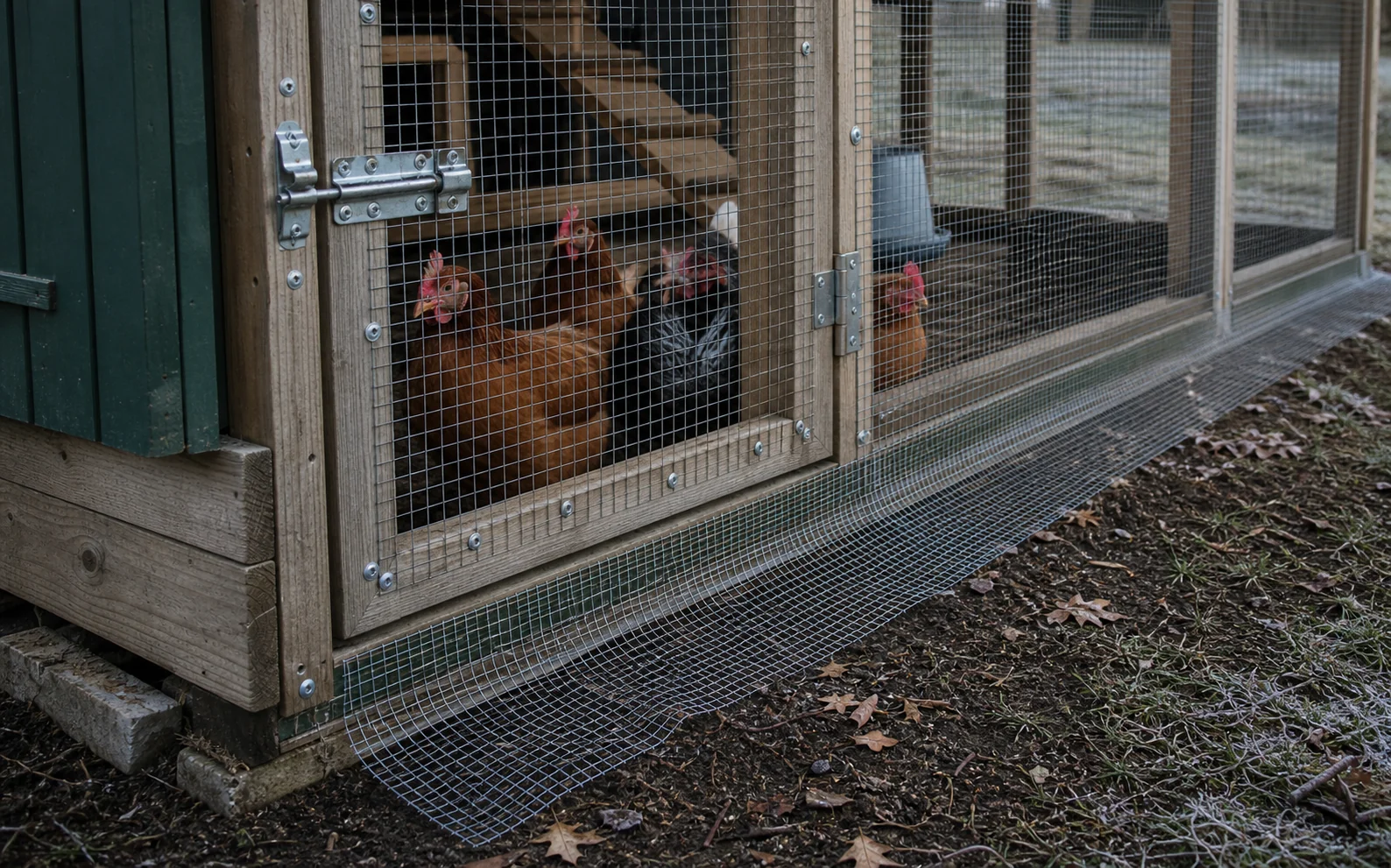
- Dig aprons around the perimeter
1/2-inch galvanized hardware cloth is a practical starting material for many backyard installations. Heavier gauge material generally resists deformation better than thin mesh.
Attach mesh with screws and washers or another structural fastening method suited to the framing. Light staples can loosen as wood moves or when an animal pulls repeatedly. Overlap seams and secure both layers rather than leaving a peelable edge.
Inspection test: press, pull, and shake each panel from the outside. If you can create a growing gap with your hands, a persistent animal may do the same overnight.
Stop digging with a perimeter apron
Burrowing predators often start where the run wall meets the ground. One common defense is an outward-facing hardware-cloth apron secured to the bottom of the run and extended across the soil before being covered or pinned.
An apron can be easier to install than a deeply buried vertical barrier, especially around roots or rocky ground. Whichever approach you use:
- Connect it securely to the wall with no weak seam.
- Protect corners and gate thresholds.
- Keep landscaping and soil movement from exposing or lifting it.
- Inspect after heavy rain, frost heave, digging pets, or construction.
Avoid assuming a heavy run is automatically dig-proof. Animals frequently work at corners, doors, and transitions between materials.
Cover the top and every overhead gap
An open run does not protect against aerial predators, climbing animals, falling branches, or wild-bird droppings. A solid roof offers weather protection, while securely fastened mesh can protect larger uncovered sections.
Pay attention to:
- The seam where walls meet the roof
- Open eaves
- Gaps beside corrugated roofing
- Tree limbs or fences that provide climbing access
- Snow and wind loads
- Drainage from the roof into the run
Lightweight wildlife netting may discourage some aerial attacks, but it is not equivalent to a structurally secured roof or welded mesh against climbing and chewing predators.
Protect vents without blocking ventilation
Do not solve predator risk by sealing the coop airtight. Chickens still need high-level ventilation to remove moisture and ammonia.
Cover every ventilation opening with securely fastened hardware cloth. Place vents so birds are not exposed to a direct draft while roosting, and make them accessible for inspection and cleaning.
Check for gaps that appear when wood shrinks, roof panels move, or a prefab coop settles. A vent is only as secure as its weakest edge.
Use latches a raccoon cannot operate
A sliding bolt, hook, or simple rotating tab may be easy for a person—and a raccoon—to move. Use a latch that requires more than one deliberate action or add a locking carabiner or padlock-compatible clip.
Good door security includes:
- A latch that cannot be shaken open
- Hinges and screws inaccessible from the outside when possible
- No flexing gap around the closed door
- A threshold that cannot be lifted or dug under
- Human doors, nest-box lids, cleanout panels, and pop doors all secured
An automatic chicken door can improve consistency, but it still needs correct installation and daily checks. Confirm that bedding, ice, dirt, or a bird cannot stop it from closing fully.
Lock chickens inside the coop at night
Penn State Extension recommends locking poultry up before dark when outside runs are not predator-proof. Even with a secure run, closing the coop at night creates another defensive layer.
Build a repeatable evening routine:
- Count the birds.
- Check that no hen is nesting outside.
- Remove spilled feed or secure the feeder.
- Close and test the pop door.
- Look along the run perimeter for fresh digging or damage.
In the morning, confirm that doors, mesh, roof edges, and latches look unchanged before releasing the flock.
Make feed storage part of predator control
Feed attracts rodents, raccoons, and other wildlife. Once animals learn that a property provides food, they may investigate the coop more aggressively.
Keep feed in a lidded metal storage container or another truly rodent-resistant container. Clean spills, avoid leaving feed accessible overnight, and keep trash and compost managed.
Do not store bags against the coop wall or in a cluttered corner where rodents can nest unseen. Inspect containers for gnawing, moisture, and damaged lids.
Use management, not traps alone
Lights, cameras, alarms, and deterrents can provide information or temporary pressure, but they do not replace physical exclusion. Predators can become accustomed to a deterrent, and devices can lose power or shift out of position.
A trail camera can help identify what is visiting and when. Use that information to repair the entry route rather than relying only on scaring the animal away.
Do not use poisons or traps without understanding local law, risks to pets and wildlife, and safe handling. Contact local wildlife authorities or a qualified professional for persistent conflicts.
A predator-proofing checklist
Coop
- Walls and floor are solid and in good repair.
- Vents and windows have securely fastened hardware cloth.
- Pop door closes without gaps.
- Human door, nest boxes, and cleanout panels use secure latches.
- Roof edges and eaves have no accessible openings.
- The structure cannot be lifted or tipped by a large animal.
Run
- Walls use appropriate welded mesh rather than chicken wire alone.
- Seams overlap and are structurally fastened.
- The top is securely covered.
- The perimeter has a connected dig barrier or apron.
- Gate corners and thresholds are protected.
- Branches and nearby objects do not create easy access.
Routine
- Birds are counted and locked in nightly.
- Feed is sealed and spills are removed.
- Damage and fresh digging are inspected daily.
- Repairs are made immediately.
- The full structure is checked after storms or ground movement.
What to do after a predator attempt
Assume the animal may return. Keep the flock in the most secure enclosure while you:
- Identify the exact entry or attempted entry point.
- Inspect the entire system, not only the obvious damage.
- Replace weak material rather than patching it with another weak layer.
- Secure feed, carcasses, eggs, or other attractants.
- Use a camera or tracks to help identify the animal.
- Contact a veterinarian promptly for any injured bird.
If a bird is missing, do not immediately leave the remaining flock exposed while searching. Secure the others first.
Frequently asked questions
Is chicken wire predator-proof?
No. It is useful for containing chickens, but it is not dependable protection against many chewing, pulling, reaching, or small-bodied predators. Use stronger small-opening mesh where exclusion matters.
What size hardware cloth should I use?
Many backyard keepers use 1/2-inch welded hardware cloth for vents, windows, walls, and aprons. Choose a durable gauge, fasten it structurally, and check local building or wildlife guidance for your specific risks.
Do I need a roof over the chicken run?
A securely covered top protects against aerial and climbing predators and reduces contact with wild birds. A solid section also provides shade and rain protection.
How often should I inspect the coop?
Look at critical edges and latches every day. Perform a deliberate full-perimeter inspection regularly and after storms, freezing, flooding, construction, or a known predator visit.
References
- Utah State University Extension: Backyard Chicken Ranching and Rodents
- Penn State Extension: Small Scale Poultry Housing
- Penn State Extension: Predator Control
- USDA APHIS: Defend the Flock Resource Center
Matched next steps
Recommended supplies for this guide
Practical options selected to fit the result above.
1/2-Inch Hardware Cloth
Predator proofingPredator-resistant mesh for runs, vents, and coop skirts. Better than chicken wire for raccoons, snakes, and loose dogs.
Why it fits: Predator proofing
Available on Amazon
Compare on Amazon →Automatic Chicken Coop Door
Nighttime lockupA timed or light-sensing door can make nightly lockup more consistent when it is installed, tested, and inspected regularly.
Why it fits: Nighttime lockup
Available on Amazon
Compare on Amazon →Trail Camera for Predator Monitoring
Predator monitoringA motion-activated camera can identify nighttime visitors so you can reinforce the actual entry route instead of guessing.
Why it fits: Predator monitoring
Available on Amazon
Compare on Amazon →Affiliate links — we may earn a small commission at no extra cost to you.