Affiliate disclosure: This guide contains affiliate links. Purchases may earn us a commission at no extra cost to you.
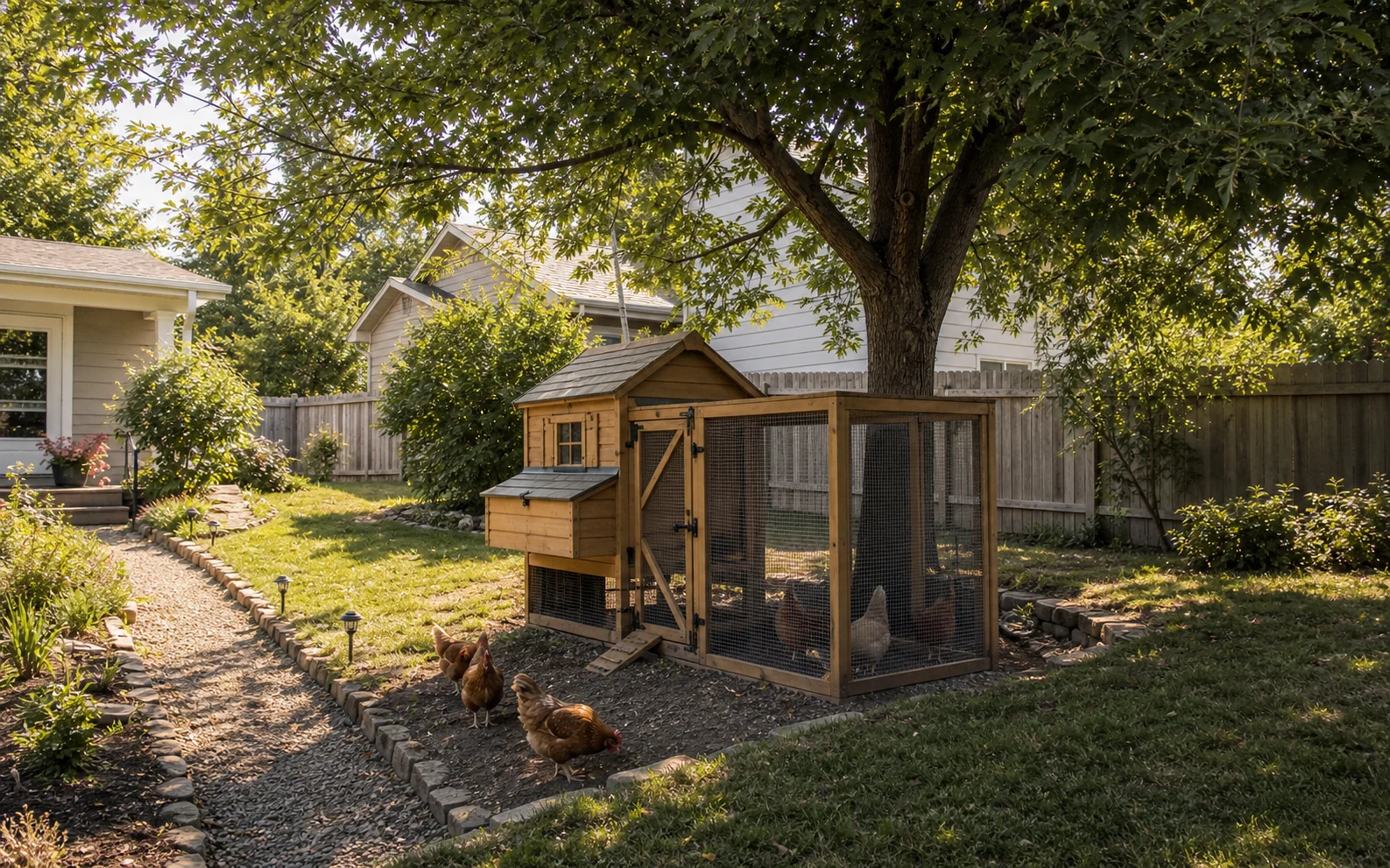
The best place for a chicken coop is a legal, well-drained part of the yard with morning sun, afternoon shade, convenient access, and enough separation from neighbors. It should also give you a practical route for carrying feed, water, bedding, eggs, and waste in every season.
Do not start by asking where the coop looks nicest. Start with the constraints that are expensive or impossible to change: local setbacks, lot lines, drainage, access, and the footprint required for your legal flock size.
Use the chicken laws directory first, then calculate the structure and run with the coop size calculator.
Choose the location in the right order.Confirm the legal flock and setback rules, calculate the required footprint, then test possible locations in your yard.
The seven checks every coop location should pass
Before building or buying, make sure the proposed location passes these checks:
- Local rules: The location satisfies city, county, zoning, permit, and HOA requirements.
- Enough space: The coop and run fit without crowding birds or blocking access.
- Drainage: Water moves away instead of pooling under the coop or turning the run into mud.
- Sun and shade: Birds get useful morning sun and protection during the hottest part of the day.
- Daily access: You can reach feed, water, eggs, and doors in rain, snow, or darkness.
- Predator exposure: The location can support a fully secured structure and run.
- Neighbor impact: Noise, dust, odor, flies, and the sight of the setup can be managed responsibly.
If a location fails a legal setback or floods after rain, reject it. Cosmetic issues are easier to solve than legal or drainage problems.
Check laws and setbacks before measuring anything else
Chicken ordinances may control more than the number of hens. A city may require the coop to be:
- In the rear yard
- A fixed distance from property lines
- A larger distance from neighboring homes
- Away from doors, windows, streets, or public areas
- On a single-family residential property
- Covered by a chicken, livestock, zoning, or structure permit
Measure from the exact point required by the ordinance. One rule may measure from the coop wall to the property line, while another measures from the entire enclosure to a neighboring dwelling.
Also check the rules that do not appear in the chicken section. Accessory-structure codes, utility easements, floodplain rules, fence requirements, HOA covenants, and rental agreements can affect the same location.
Simple site-plan habit: draw the house, lot lines, nearby homes, proposed coop, full run, doors, gate, feed storage, and every required distance. This catches placement problems before materials arrive.
Put the coop on high, well-drained ground
Penn State Extension recommends well-drained ground for small poultry housing because persistent dampness creates unhealthy housing and run conditions. A low spot that stays wet after a storm is a poor coop site even if it looks flat and convenient during dry weather.
Watch the yard during and after rain. Look for:
- Standing water
- Roof runoff
- Downspout discharge
- Water flowing from neighboring property
- Soil that remains soft after the rest of the yard dries
- A slope that directs water through the future run
The goal is not perfectly dry soil every day. The goal is to prevent repeated saturation around the coop, feeder, waterer, and high-traffic gate.
Helpful site improvements can include a raised foundation, roof gutters, a shallow diversion swale, appropriate gravel in human walkways, and a thick layer of replaceable organic run material. Do not redirect stormwater onto neighboring property.
Balance morning sun and afternoon shade
Sunlight helps dry the coop area and can make winter chores more pleasant. Too much direct summer sun, however, can overheat the coop and run.
A useful general arrangement is:
- Morning sun to warm and dry the area
- Afternoon shade from a building, deciduous tree, roof extension, or shade cloth
- Year-round ventilation that is not blocked by a solid fence or wall
- Weather protection from the prevailing wind and driving rain
Shade must cover places where birds actually spend time, including the run, water station, and dust-bathing area. A tiny shaded corner is not enough for the full flock during a hot afternoon.
Avoid relying on dense vegetation as the only shade. Shrubs can hide predators, trap moisture, block airflow, or grow into the run. Keep enough clearance to inspect and repair every side.
Make daily access boringly easy
A coop that is easy to reach gets checked more consistently. You will visit it in bad weather, before sunrise, after dark, and when carrying awkward supplies.
Plan a route that works for:
- A full bag or container of feed
- Buckets of water during a plumbing failure
- Bedding and cleaning tools
- A wheelbarrow or waste container
- Egg collection without walking through the run
- Emergency access to a sick or injured bird
- Snow removal or muddy-season footing
Place the human door and run gate where they can open fully without hitting a fence, slope, or snowbank. Leave working room around latches, cleanout panels, vents, and roof edges.
If possible, keep the coop within sight of the house. Visibility makes it easier to notice an open door, damaged run, unusual flock behavior, or a predator investigating the perimeter.
Think carefully before adding electricity or plumbing
Nearby electricity can support lighting, a camera, or winter water equipment, but permanent wiring must be installed safely and may require permits. Long-term extension-cord use creates trip, weather, and fire risks.
Water nearby makes chores easier, but a hose connection should not discharge inside the coop or create a permanently wet zone around the waterer. Plan how water will drain when containers are cleaned.
Before digging posts, aprons, conduit, or drainage features, locate underground utilities and identify recorded easements. A coop that blocks utility access may need to be moved later.
Leave room for a predator-resistant perimeter
The coop footprint is not just the building. Include the run, roof overhang, gates, buried or surface aprons, drainage, and enough exterior working room for repairs.
A fence tight against the coop can prevent you from inspecting a chewed corner or loose fastener. A tree limb over the run can give climbing predators a route to the roof. A shed or woodpile beside the coop can hide rodents and make exclusion harder.
For vulnerable openings and run walls, 1/2-inch hardware cloth offers more predator resistance than conventional chicken wire. Read the full predator-proof chicken coop guide before finalizing the foundation and run edges.
Reduce neighbor friction before it starts
Even a legal coop can create conflict if it is placed beside a neighbor’s patio, bedroom window, or property-line fence.
When you have a choice, place the coop where you can manage:
- Early-morning hen noise
- Feed dust and loose bedding
- Manure storage and removal
- Flies and rodents
- Roof runoff
- Lighting and camera placement
- The visual appearance of the structure
Keep feed sealed, remove wet bedding, manage manure before odors develop, and avoid directing bright security lights or drainage toward neighboring property. A clean setup with predictable care is easier to live beside.
Compare candidate locations with a scorecard
If two or three parts of the yard could work, score each from 0 to 2.
Reject any site that scores zero for legal fit. Then compare drainage, access, predator security, shade, utilities, and neighbor impact. The highest total is usually more useful than the prettiest view.
Common placement mistakes
Avoid these expensive errors:
- Buying a coop before confirming the legal setback
- Using a seasonal low spot that floods in spring
- Putting the run in full afternoon sun
- Forgetting space for gates, cleaning, and repairs
- Blocking a utility easement or drainage path
- Placing feed storage where rodents can shelter nearby
- Building directly against a fence that prevents inspection
- Assuming free-ranging eliminates the need for a full-size secure run
- Locating the coop close to a neighbor simply because the far side of the yard is less convenient
A practical placement sequence
- Check the local chicken laws and private restrictions.
- Choose a legal flock size.
- Use the coop size calculator to establish the full footprint.
- Draw candidate sites with setbacks and easements.
- Observe drainage, sun, shade, wind, and access.
- Plan predator protection and the cleaning route.
- Estimate the complete project with the startup cost calculator.
- Confirm permits before buying or building.
Frequently asked questions
How far should a chicken coop be from the house?
There is no universal distance. Follow the controlling local setback, then choose enough separation to manage noise, odor, flies, and drainage without making daily care difficult.
Should a chicken coop be in sun or shade?
A mix is useful: morning sun can help dry the area, while afternoon shade helps limit heat. The run, water, and resting areas need effective shade during hot weather.
Can I put a chicken coop on gravel?
Gravel can help human walkways and drainage layers, but it is not a complete management surface for the birds. Chickens still need comfortable, cleanable areas for scratching and dust bathing, and the site must not collect contaminated runoff.
Should the coop be close to the house?
Close enough for consistent care and observation is helpful, provided laws, drainage, noise, and sanitation allow it. Convenience should not override a required setback.
References
- Penn State Extension: Small Scale Poultry Housing
- University of Minnesota Extension: Caring for Chickens in Cold Weather
- USDA APHIS: Defend the Flock
Matched next steps
Recommended supplies for this guide
Practical options selected to fit the result above.
1/2-Inch Hardware Cloth
Predator proofingPredator-resistant mesh for runs, vents, and coop skirts. Better than chicken wire for raccoons, snakes, and loose dogs.
Why it fits: Predator proofing
Available on Amazon
Compare on Amazon →UV Shade Cloth for Chicken Runs
Heat protectionRun shade for Texas heat and exposed yards. Helps lower heat stress when ordinances require birds to stay enclosed.
Why it fits: Heat protection
Available on Amazon
Compare on Amazon →Galvanized Feed Storage Can
Pest controlRodent-resistant feed storage that helps prevent pests, odors, and nuisance complaints.
Why it fits: Pest control
Available on Amazon
Compare on Amazon →Affiliate links — we may earn a small commission at no extra cost to you.